Spiti Valley Winter 2026–27: Complete Travel Guide, 8-Day Itinerary, Snow, Routes & Safety Tips
A practical winter guide to Spiti Valley covering the Shimla–Kinnaur route, 8-day itinerary, snow destinations, road conditions, extreme cold precautions, packing, accommodation and essential safety tips.
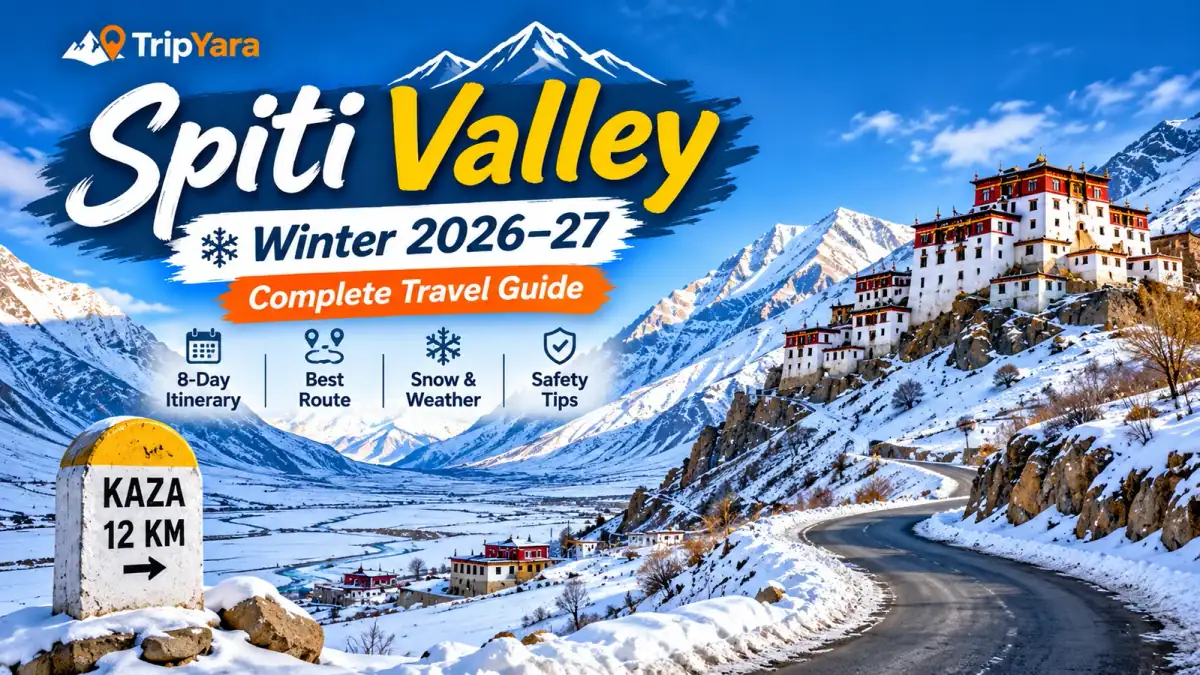
Spiti Valley in winter is a completely different experience from the usual summer road trip. Snow-covered villages, frozen streams, dramatic mountains, monasteries surrounded by white landscapes and extremely clear skies make the valley look almost unreal.
But winter Spiti is not a normal road trip.
Temperatures can fall to around -20°C or lower in the coldest parts of winter, and road connectivity can change quickly after snowfall. The biggest mistake travellers make is assuming that the famous Manali–Kaza route remains available in winter.
For December, January, February and early March, the itinerary should be designed around the Shimla–Kinnaur–Kaza route, subject to current weather and road conditions.
Why Visit Spiti in Winter?
Winter Spiti is ideal for travellers who want a quieter and more raw Himalayan experience.
You can expect:
- Snow-covered villages
- Frozen waterfalls and streams
- Snow around Key Monastery
- White landscapes around Kaza
- Extremely clear mountain views on good-weather days
- Less tourist congestion
- Traditional winter life in Spiti villages
- A chance to experience the valley in its harshest season
However, winter also means fewer accommodation and transport choices compared with summer.
Best Time for Winter Spiti
December
December is a good option if you want the beginning of the winter transformation. Snow conditions can vary significantly from one week to another, so don't plan purely around photographs seen online.
January
January is among the coldest periods.
Expect:
- Severe nighttime cold
- Frozen water pipes in some properties
- Snow and ice on roads
- Very limited daylight for sightseeing
- Difficult driving conditions
February
February remains extremely cold, but daylight gradually improves. Losar, the Tibetan New Year, is traditionally associated with February, although exact dates vary according to the lunar calendar.
March
March can offer a slightly easier travel experience than peak winter, but don't assume roads will suddenly become summer-like. Snow and weather can still disrupt travel.
The Most Important Thing: Which Route Is Open?
Manali → Kaza via Kunzum Pass
Do not plan your winter trip around this route.
The Keylong–Kaza road through Kunzum Pass generally remains closed during winter because of heavy snowfall. The official district road-status information should be checked immediately before departure.
This means the following should not be treated as a dependable winter route:
Manali → Atal Tunnel → Batal → Kunzum → Losar → Kaza
Chandratal should also not be included as a normal winter road-trip stop. Access is seasonal and highly dependent on snow and road conditions.
Recommended Winter Route
For winter, plan from the Shimla side:
Delhi → Shimla → Narkanda → Rampur → Reckong Peo → Kalpa → Nako → Tabo → Dhankar → Kaza → Key → Kibber → Langza → Hikkim
The Shimla–Kaza corridor is the practical winter approach, but accessibility remains dependent on prevailing weather and road conditions.
8-Day Winter Spiti Itinerary
Day 1: Delhi → Shimla
Start early from Delhi.
Stay: Shimla
Keep this day mainly for reaching Shimla and preparing for the higher-altitude journey.
Avoid trying to continue deep into Kinnaur after a long Delhi drive.
Day 2: Shimla → Narkanda → Rampur → Reckong Peo
Approximate route:
Shimla → Narkanda → Rampur → Jeori → Powari → Reckong Peo
Stay: Reckong Peo
This is an important acclimatisation day because you're gradually gaining altitude.
If road or weather conditions deteriorate, don't force the journey.
Day 3: Reckong Peo → Nako → Tabo
Continue towards the Spiti side through Kinnaur.
Possible stops:
- Khab
- Nako
- Nako Lake
- Sumdo
- Tabo
Stay: Tabo
Tabo
Tabo is one of the most important cultural stops in the valley.
Visit:
- Tabo Monastery
- Old village area
- Surrounding snow-covered landscape
Don't try to cover too many places after sunset.
Winter mountain driving should primarily be done during daylight.
Day 4: Tabo → Dhankar → Kaza
Start early.
Route:
Tabo → Dhankar → Sichling → Atargoo → Kaza
If weather permits, visit Dhankar Monastery.
Then continue towards Kaza.
Stay: Kaza
Kaza is the main base for exploring central Spiti.
Day 5: Kaza → Key Monastery → Kibber
Start after breakfast, depending on weather.
Key Monastery
Key Monastery is one of the defining landmarks of Spiti and is located close to Kaza.
Spend time around the monastery rather than rushing through it.
Then continue towards:
Kibber
Kibber is a high-altitude village, so take the altitude seriously.
Winter caution
Don't underestimate the altitude.
Avoid strenuous walking.
If you're experiencing:
- Severe headache
- Unusual breathlessness
- Confusion
- Extreme weakness
- Persistent vomiting
stop sightseeing and seek medical/local assistance.
Day 6: Kaza → Langza → Hikkim → Komic → Kaza
This is your classic high-village day.
Langza
Known for:
- Giant Buddha statue
- Himalayan scenery
- Fossils
- Traditional village architecture
Hikkim
Visit the famous high-altitude post office area if accessible.
Komic
Komic is one of the highest villages associated with Spiti's tourism circuit.
But remember:
Winter accessibility is weather-dependent.
Don't treat these village roads as guaranteed sightseeing routes.
If fresh snowfall or road icing occurs, turn back.
Day 7: Kaza → Tabo / Nako
Start the return journey early.
Depending on road conditions and your next destination, stay at:
Tabo or Nako
This is intentionally not designed as a single-day Kaza → Delhi return.
That would make the trip unnecessarily exhausting and risky.
Day 8: Nako / Tabo → Kinnaur → Shimla
Continue back through the Kinnaur side.
Depending on the road condition and your departure plan, you can stay in Shimla or continue further only if daylight, weather and road conditions are favourable.
For travellers returning to Delhi, an additional buffer day is better than trying to force the entire return journey.
How Many Days Are Actually Better?
Minimum
7–8 days
Better
8–10 days
Comfortable
10–12 days
The additional days are valuable because snowfall can force you to stay put.
This is one of the biggest differences between a normal summer Spiti itinerary and a winter Spiti itinerary.
Winter Spiti Packing List
Don't pack for a normal hill-station trip.
Clothing
- Heavy down jacket
- Thermal innerwear
- Fleece layer
- Woollen sweater
- Waterproof outer layer
- Woollen socks
- Insulated gloves
- Waterproof shoes
- Woollen cap
- Neck warmer
- Sunglasses
Essential Items
- Sunscreen
- Lip balm
- Moisturiser
- Personal medicines
- Power bank
- Torch or headlamp
- Thermos
- Reusable water bottle
- Offline maps
- ID proof
- Emergency cash
Most Important Winter Cautions
1. Don't Depend on Google Maps Alone
A route showing on Maps does not mean that it is currently safe or open.
Mountain roads can be:
- Blocked by snow
- Covered with black ice
- Affected by landslides
- Temporarily closed by administration
- Accessible only to certain vehicles
Check official road-status information and local advisories before starting each major leg.
2. Avoid Night Driving
After sunset:
- Temperatures fall rapidly
- Ice can form on roads
- Visibility can deteriorate
- Roadside help becomes difficult
- Mobile connectivity may be limited
Plan your driving so that you reach your accommodation before dark.
3. Don't Chase Snowfall
Fresh snowfall looks beautiful, but driving during or immediately after heavy snowfall can become dangerous.
If local authorities or experienced local drivers advise waiting:
wait.
Missing one sightseeing spot is better than getting stranded.
4. Don't Assume Every Homestay Is Open
Winter accommodation is much more limited than summer.
Before leaving, confirm:
- Is the property open?
- Is heating available?
- Is hot water available?
- Is the room heated at night?
- Is food available?
- Is electricity reliable?
- Can the property arrange local transport if roads close?
5. Carry a Buffer Day
A winter itinerary should never be so tightly scheduled that one snowfall ruins the entire trip.
Keep at least one spare day, preferably two if your schedule allows.
Fuel Planning
Kaza has a fuel station, but don't assume every remote village will have fuel available.
Keep the tank sufficiently filled before entering remote stretches.
For a winter road trip, fuel planning should be conservative.
If travelling by private vehicle, check the vehicle thoroughly before departure:
- Battery
- Tyres
- Brakes
- Coolant
- Engine oil
- Heater
- Spare tyre
- Recovery equipment
Network & Communication
Spiti has limited connectivity.
BSNL generally has better coverage than many other networks in remote parts of Spiti, but connectivity and internet availability can vary significantly by location.
Therefore:
- Download offline maps
- Save hotel numbers
- Keep emergency contacts offline
- Inform family about your route
- Don't depend entirely on mobile internet
Accommodation in Winter
Winter accommodation is much more limited than summer.
Before leaving, confirm:
- Heating arrangement
- Hot water availability
- Food availability
- Electricity backup
- Road access
- Check-in availability
- Whether the property remains open during heavy snowfall
A property that appears online does not necessarily mean it will be operating normally during extreme winter weather.
Medical & Altitude Precautions
Spiti is remote, so medical planning is important.
For winter travel:
- Don't overexert yourself on Day 1
- Stay hydrated
- Avoid heavy alcohol consumption
- Sleep properly
- Acclimatise gradually
- Don't ignore serious altitude symptoms
If symptoms become severe, stop travelling and seek medical assistance. Do not attempt to push through severe symptoms simply to maintain the itinerary.
What Not to Include in a Winter Spiti Itinerary
Avoid presenting these as guaranteed winter stops:
- Chandratal
- Kunzum Pass crossing
- Manali–Kaza circuit
- Long off-road village detours after snowfall
- High-altitude trekking without proper preparation
These are seasonal or highly weather-dependent activities and should only be considered when local conditions and official access permit them.
Winter Spiti Budget Planning
Instead of relying on a fixed package price, calculate your trip budget through:
- Delhi → Shimla transport
- Shimla/Kinnaur accommodation
- Kaza accommodation
- Private vehicle or local taxi
- Fuel
- Food
- Emergency buffer
- Extra stay days due to snowfall
Keep an additional 15–25% emergency buffer because winter delays can force an extra hotel night, vehicle expense or route change.
Is Winter Spiti Worth It?
Yes — if you're prepared for the conditions.
Winter Spiti is not about ticking off 15 tourist spots every day.
It's about:
- Snow-covered monasteries
- Silent villages
- Frozen landscapes
- Buddhist culture
- Clear Himalayan skies
- Slow travel
- Experiencing one of India's harshest inhabited mountain regions
But if your priority is a comfortable road trip with predictable roads, the warmer travel season is much easier.
Final Winter Spiti Checklist
Before starting:
- Check official road status
- Confirm Shimla–Kinnaur–Kaza route
- Do not plan on the Kunzum/Manali route in winter
- Check weather forecast
- Confirm winter accommodation
- Carry heavy winter clothing
- Carry medicines and first-aid
- Download offline maps
- Keep extra cash
- Keep fuel buffer
- Avoid night driving
- Keep 1–2 buffer days
- Follow local administration advisories
TripYara Quick Recommendation
Best winter route: Delhi → Shimla → Reckong Peo → Nako → Tabo → Dhankar → Kaza → Key → Kibber → Langza → Hikkim → Kaza → return via Kinnaur
Best duration: 8–10 days
Best for: Snow, monasteries, remote Himalayan villages and winter landscapes
Avoid: Manali–Kaza/Kunzum crossing in winter
Golden rule: Weather decides the itinerary, not Google Maps.
- #spiti valley
- #spiti valley winter
- #himachal pradesh
- #kaza
- #key monastery
- #langza
- #hikkim
- #nako
- #tabo
- #winter road trip
- #spiti itinerary
- #snowfall in spiti